

Plug in JSON API Readonly Webserver
· 2 min read
All our microservices expose kinda heartbeat interfaces to
Consul
which we use as a health check. Some of the services also provide some access to the internal data they deal with. I am not talking about their main duties: those are very well handled by
RabbitMQ
and
Redis
.
Just sometimes it makes sense to export data that is indeed there to other services that might require it. For instance, I want to completely get rid of Redis in favour of in-house solution for key-value pair storage as we successfully did exactly one year ago with PubSub .
So instead of re-inventing a wheel with every new microservice, I decided to create a pluggable library, that might be serving any arbitrary data from any application with zero code (if we don’t count 5-LoCs
config.exs
.)
The solution is based on this Dave Thomas’ tweet .
Lightweight Json API Server, Embeddable Into Any Project
Camarero is a ready-to-use solution to add some JSON API functionality to the existing application, or to implement the read-only JSON API from the scratch when more sophisticated (read: heavy ) solutions are not desirable. Below is the typical picture of how Camarero is supposed to be plugged in.
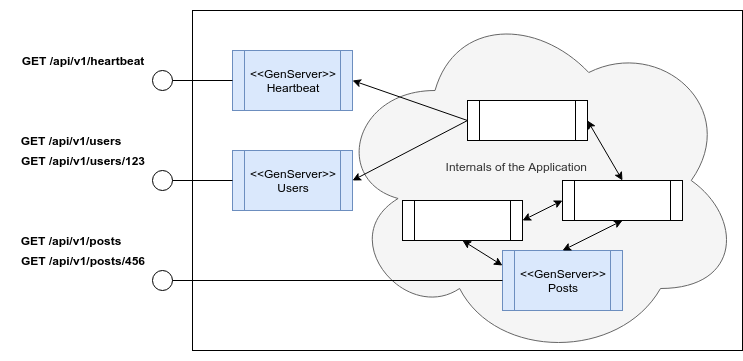
It is designed to be very simple and handy for read-only web access to the data. It might indeed be a good candidate to replace Redis or any other key-value store. It is blazingly, dead fast.
Here are response times for the 1M key-value storage behind.
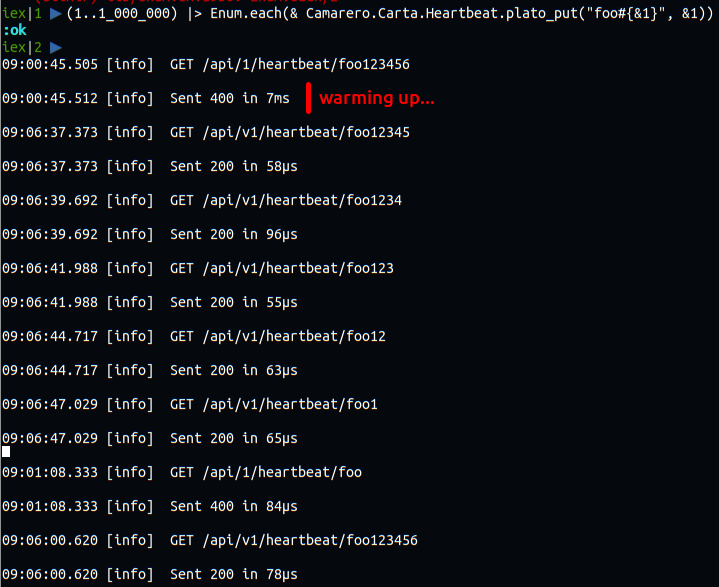
Yes, that’s it. The response time for the request against one million key-values store takes dozens of microseconds .
Implementation details
Camarero is supposed to be plugged into the functional application. It handles the configured routes/endpoints by delegating to the configured handler modules. The simplest configuration might looks like:
config :camarero,
  carta: [Camarero.Carta.Heartbeat],
  root: "api/v1"
The above is the default;
/api/v1
would be the root of the web server, single
Camarero.Carta.Heartbeat
module is declared as handler. The handlers might be also added dynamically by calls to
Camarero.Catering.route!
.
Handlers
Handler
is a module implementing
Camarero.Plato
behaviour. It consists of methods to manipulate the conteiner behind it. Any module might implement this behaviour to be used as a handler for incoming HTTP requests.
There is also
Camarero.Tapas
behaviour scaffolding the container implementation inside
Camarero.Plato
.
The default implementation using
%{}
map as a container, looks pretty simple:
defmodule Camarero.Carta.Heartbeat do
  use Camarero.Plato
end
This is an exact exerpt from
Heartbeat
module that comes with this package. For more complicated/sophisticated usages please refer to the
documentation
.
All the methods from both
Camarero.Tapas
and
Camarero.Plato
default implementations are overridable. E. g. to use the custom route for the module (default is the not fully qualified underscored module name,) as well as custom container, one might do the following:
defmodule Camarero.Carta.Heartbeat do
  use Camarero.Plato, container: %MyStructWithAccessBehaviour{}

  @impl true
  def plato_route(), do: "internal/heartbeat"
end
Web server config
Camarero
runs over
Cowboy2
with
Plug
. To configure
Cowboy
, one might specify in the
config.exs
file:
config :camarero,
  cowboy: [port: 4001, scheme: :http, options: []]
Installation
def deps do
  [
    {:camarero, "~> 0.1"}
  ]
end
Happy serving!